The Energy Transition Cannot Succeed Without AI
The public debate asks whether artificial intelligence helps or hinders the move to clean power. However, the question misses the mark because a modern grid cannot be operated, built or afforded without AI.

AI and the electricity system are now intertwined. Training advanced models consumes significant power and data centres are among the fastest-growing loads on the grid.1 But AI, in all its forms (machine learning, predictive modelling, automation, LLMs etc.), is also becoming the core machinery for running a clean, decentralised system built on weather-dependent renewables and millions of small, distributed assets.
Public debate oversimplifies AI and energy into one question: does AI help or hurt the transition? Few however ask whether Britain can operate, build and afford the transition at the required pace without it. The answer to that question is, emphatically, no. The future system cannot be operated without AI. It cannot be built at the required pace without it. And, once the costs are counted, it cannot be afforded any other way.
01. The system cannot be operated without AI
Gone are the days when the most difficult challenge was the surge of kettles switched on when EastEnders finished or at half-time during the World Cup. The transition will turn a relatively centralised, predictable machine into one which is vast, weather-dependent and decentralised. The new grid is increasingly dominated by forecasting, optimisation and control. It can be planned, governed and regulated by humans, but it cannot be operated at the required speed, scale and precision without AI. No human control room can keep up.
Here in the UK, zero-carbon sources are now the largest part of supply (51%), with wind alone providing 30% of British electricity in 2024.2 Demand from EVs and heat pumps, together with rooftop solar and home batteries, is now flexible and bidirectional. The National Energy System Operator (NESO) is expecting that demand to rise from about 290 TWh today to as much as 785 TWh by 2050, balanced across millions of those smaller devices rather than a few hundred large ones.3

The difficulty of running the new system with old methods is already showing. The Renewable Energy Foundation puts the volume of wind generation discarded in 2024 at 8.3 TWh, roughly a tenth of Britain’s wind output, because the network could not move the power to where it was needed.4 However, the clearest evidence that the new system cannot be run manually is that NESO has already stopped trying. Its Open Balancing Platform was built to increase utilisation of batteries and thousands of smaller energy assets because engineers dispatching unit by unit could not keep pace with the swelling fleet. In a little over a year (Oct 23-March 25), NESO reports that daily average dispatch volumes for batteries rose by 425% and the instructions issued to them by 1,347%.5 NESO has taken similar action on forecasting, where every megawatt of uncertainty must be covered by reserve, typically a gas plant. The Quartz Solar tool now running in NESO’s control room, has halved large solar forecast errors and is 2.8 times more accurate than the tools it replaced, leaving fewer fossil units idling on standby and cutting around 300,000 tonnes of CO₂ a year.6
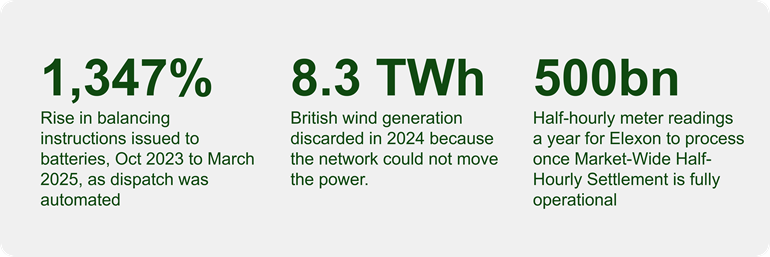
These applications will only grow because the problems they solve keep growing in complexity. Physically, as synchronous thermal plants retire, the system loses inertia and maintaining a stable frequency and voltage becomes more technically challenging. Informationally, the data volumes continue to surge. Once complete, Market-wide Half-Hourly Settlement (MHHS) will have Elexon processing up to 500 billion half-hourly metre readings a year.7 Both are exactly the kinds of problem that advanced control and prediction are built to address.
A system already beyond manual operation at 51% renewables will not be run by people alone at 95%; “cannot be operated without AI” is simply acknowledging the reality today.
02. The system cannot be built at the pace required without AI
The delivery challenge is now too large, too compressed and too information-intensive for conventional planning and project controls. The clean-power target implies around £40bn of investment a year from 2025 to 2030 across up to 126GW of renewable generation, up to 33GW of storage and 80 network and enabling infrastructure projects.8 National Grid, which historically delivered roughly one major transmission project a year, is now delivering 17 at once under Ofgem’s Accelerated Strategic Transmission Investment framework.9 National Grid said in 2024 that Britain must build five times as much electricity transmission infrastructure by 2030 as it did in the previous 30 years.10 Under the RIIO-T3 price control that construction requirement is now funded and represents close to a quadrupling of transmission spending against the preceding five-year period.11
There are three core constraints.

i. The connection queue
Contracted offers in the transmission demand queue grew by around 470% between November 2024 and June 2025 and some customers have been offered connection dates in the late 2030s, yet applications are still appraised manually and sequentially.12 AI radically transforms this. National Grid Electricity Distribution and Yottar are building a platform for automated grid capacity assessment, intended to streamline connection engineers’ workflows, help developers identify viable projects earlier and so reduce speculative applications, enabling faster project development and better use of existing infrastructure.13 While in the US, PJM uses HyperQ, an agentic tool built by Google’s Tapestry, to read interconnection applications of thousands of pages, some running to 6,000, in minutes rather than weeks.14
ii. The supply chain
High-voltage cable now takes two to three years to procure, and large transformers up to four, with lead times roughly doubling since 2021.15 Here AI’s role is narrower but still considerable, sharpening demand forecasting, inventory planning and extending asset life through predictive maintenance, even if it cannot make a transformer any faster.
iii. The People
The clean-energy workforce must roughly double from about 440,000 in 2023 to around 860,000 by 2030, some 400,000 additional workers across 31 priority occupations including engineers, electricians and welders.16 However, there are not enough training routes to close this gap. There are objectively not enough people. The only answer is to increase the output of the people we have. Reading a 6,000-page application line by line was never the best use of an engineer’s time and freeing it is, in effect, adding capacity.
AI is not a substitute for planning reform, grid investment or skilled people but it is the delivery accelerator that enables those reforms and augments the existing workforce to help bridge the gap. The UK can build individual projects without AI. It cannot build the new energy system quickly enough without it.
03. The system cannot be afforded any other way
The transition is affordable only if electricity becomes cheaper. The only credible route to that is a smarter, AI-enabled system. A committed government will always find the budget but this is about whether that can be achieved at a cost households, businesses, taxpayers and investors will bear.
UK industrial users paid around 50% more for electricity than competitors in France and Germany in 2023, and four times as much as those in the US.17 Domestic customer energy debt reached £4.43bn by June 2025, up 71% since 202318 and about 11% of English households were in fuel poverty in 2024.19 The transition cannot be financed by passing more system cost through household bills.
Without AI, complexity and uncertainty must be absorbed through constraint payments and expensive physical redundancy: more reinforcement, back-up and “just in case” capacity than otherwise needed. That redundancy and constraint payments, compensation paid to renewable energy generators for unused energy, are ultimately paid for by consumers. Affordability is therefore really a question of efficiency.
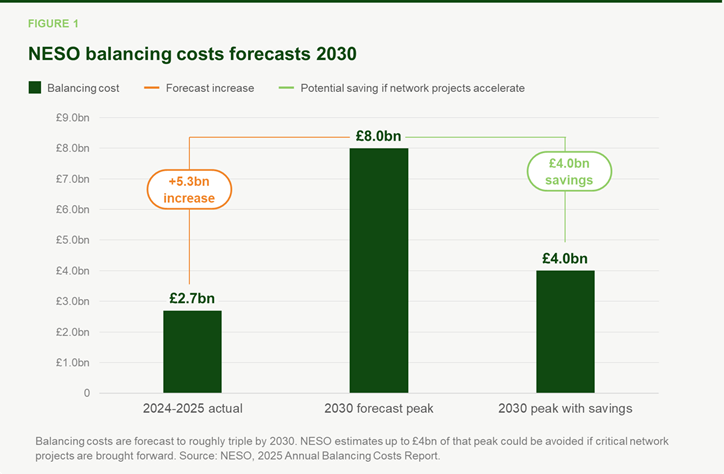
NESO spent £2.7bn balancing the system in 2024-25, up 10% on the year, and that cost is forecast to climb towards £8bn in 2030. In 2024 alone, £393 million in direct constraint payments were made to discard wind that had already been generated.4 To combat this NESO estimates that the 2030 balancing peak could be reduced by up to £4bn if critical network projects are brought forward.20 As demonstrated, that delivery acceleration is dependent on AI. Alongside this, tools such as Quartz Solar, are also being used to reduce the balancing costs. From a single variable it has already cut around £30m a year from the reserve NESO must hold.6 Without more tools such as these, the UK pays twice: once to build clean-energy generation and again to manage power it cannot move, store or use efficiently.
Rising costs also decide whether projects get built at all. They erode investor confidence, construction feasibility and the wider momentum of the transition. In May 2025, Ørsted discontinued the 2.4 GW Hornsea 4 project in its current form and Drax withdrew its 600 MW Cruachan II pumped-storage expansion from the first window of the long-duration storage cap and floor scheme — Ørsted citing supply chain costs and execution risk, Drax citing rising capital costs and unclear recovery of its investment.21 When costs rise, projects turn fragile and opponents gain an easy argument that clean power is too expensive.
AI lets the system use information before it uses capital, targeting investment where it adds most value and using existing assets more efficiently. The cheapest unit of capacity is often a heat pump shifted by half an hour or an EV charged overnight, rather than a new power line. The government, Ofgem and NESO estimate flexibility could deliver up to £70bn of savings by 2050, but only if millions of assets can be found, forecast and dispatched at the right time — which manual processes simply cannot achieve.22

Conclusion
Fundamentally, the system cannot be operated, companies cannot build fast enough and the system cannot be afforded without AI. It is what lets Britain shift from a capital-heavy transition to an intelligence-led one, where infrastructure is still built at scale but used far more efficiently. The energy transition is not waiting for AI to arrive; it is already running on it, and it cannot be finished without it.


Bibliography
- [1] International Energy Agency, Energy and AI (World Energy Outlook Special Report, 2025). iea.org/reports/energy-and-ai
- [2] NESO, “Britain’s Electricity Explained: 2024 Review.” neso.energy/news/britains-electricity-explained-2024-review
- [3] NESO, Future Energy Scenarios 2025: Pathways to Net Zero (July 2025). neso.energy/publications/future-energy-scenarios-fes
- [4] Renewable Energy Foundation, “Discarded wind energy increases by 91% in 2024” (January 2025). ref.org.uk/ref-blog/384-discarded-wind-energy-increases-by-91-in-2024
- [5] NESO, “Skip rates”, balancing overview. neso.energy/industry-information/balancing-services/skip-rates
- [6] Open Climate Fix, “National Energy System Operator adopts AI solar forecasting to save £30m and slash 300,000 tonnes of CO₂ every year.” NESO, “How solar is providing secure, clean and affordable energy to Great Britain.” https://www.openclimatefix.org/insights/neso-adopts-ai-solar-forecasting-control-room
- [7] Elexon, “Market-wide Half Hourly Settlement and the BSC” (implementation completing May 2027). elexon.co.uk/bsc/operational/market-wide-half-hourly-settlement
- [8] Department for Energy Security & Net Zero, Clean Power 2030 Action Plan (December 2024). gov.uk/government/publications/clean-power-2030-action-plan. Renewable and storage figures are sums of the upper bounds of the plan’s capacity ranges: offshore wind 43-50GW, onshore wind 27-29GW, solar 45-47GW; batteries 23-27GW, long-duration storage 4-6GW.
- [9] National Grid, Strategic Infrastructure investor seminar transcript (Carl Trowell, 15 May 2025): the 17 ASTI projects within National Grid’s jurisdiction were awarded at the end of 2022. nationalgrid.com/document/560296/download
- [10] National Grid, The Great Grid Upgrade: five times more electricity transmission infrastructure by 2030 than was built in the previous 30 years, stated 2023 and restated in 2024 on award of the Great Grid Partnership. cityam.com/national-grid-needs-tens-of-billions-to-hit-net-zero-goals-boss-warns
- [11] Ofgem, RIIO-3 Final Determinations for the Electricity Transmission, Gas Distribution and Gas Transmission sectors (4 December 2025), and RIIO-3 investor call transcript, 4 December 2025. ofgem.gov.uk/decision/riio-3-final-determinations-electricity-transmission-gas-distribution-and-gas-transmission-sectors
- [12] Ofgem, “Demand connections update” (6 November 2025), citing Energy Networks Association connections data, ofgem.gov.uk/guidance/demand-connections-update; Ofgem, “Update on reform to the electricity connections process following proposals from the ESO” (April 2024), on connection dates in the late 2030s.
- [13] Theenergyst, “National Grid Electricity Distribution and Yottar launch partnership to accelerate grid connections” (March 2026). theenergyst.com
- [14] “Tapestry is using AI to help PJM clear its interconnection backlog,” Latitude Media; PJM/Google/Tapestry announcement (April 2025). latitudemedia.com; insidelines.pjm.com
- [15] International Energy Agency, Building the Future Transmission Grid (February 2025). iea.org/reports/building-the-future-transmission-grid
- [16] Department for Energy Security & Net Zero, Clean Energy Jobs Plan (October 2025). gov.uk/government/publications/clean-energy-jobs-plan
- [17] Deloitte, “Why Britain pays more for electricity” (28 July 2025), using IEA 2023 data, as cited in House of Lords Library, “Electricity prices in Great Britain.”
- [18] Ofgem, “Debt strategy update: supporting the reduction of energy debt.” ofgem.gov.uk/policy/debt-strategy-update-supporting-reduction-energy-debt
- [19] House of Commons Library, “Fuel poverty in the UK” (CBP-8730). commonslibrary.parliament.uk/research-briefings/cbp-8730/
- [20] NESO, 2025 Annual Balancing Costs Report (June 2025). neso.energy/industry-information/balancing-costs
- [21] Ørsted, “Ørsted to discontinue the Hornsea 4 offshore wind project in its current form” (7 May 2025); Drax, trading update (1 May 2025); Bloomberg, “Drax Pauses Plans for Crucial Energy Storage Site as Costs Rise” (May 2025).
- [22] DESNZ, Ofgem and NESO, Clean Flexibility Roadmap (July 2025), and the July 2026 update. gov.uk/government/publications/clean-flexibility-roadmap
